
Harold Göthson om Carla Rinaldis arv
2026-06-22
Den 11 juni deltog Harold Göthson i lanseringen av INSPIRE, ett nytt internationellt forskningsinitiativ som drivs av Fondazione Reggio Children i samarbete med LEGO Foundation. I sitt tal, Carla Rinaldi and Democratic Citizenship, lyfte han fram Carla Rinaldis syn på utbildning som en del av ett bredare kulturellt och demokratiskt projekt. Här publiceras talet i sin helhet på engelska.
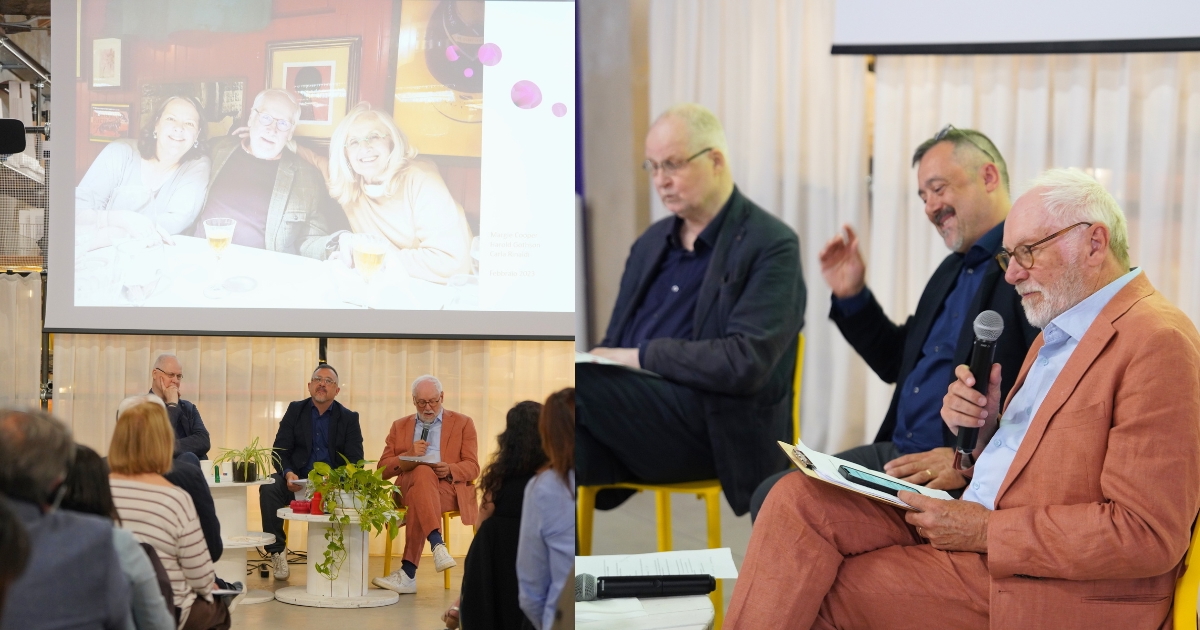
Den 11 juni lanserade Fondazione Reggio Children, i samarbete med LEGO Foundation, forskningsinitiativet INSPIRE (INclusive and Sustainable Playful Innovation and Research in Education) i Reggio Emilia. Det femåriga initiativet syftar till att främja forskning och innovation inom utbildning, samhälle och policy, med utgångspunkt i Carla Rinaldis kulturella arv.
Vid evenemanget medverkade Harold Göthson, en av Reggio Emilia Institutets grundare och Reggio Emilia Institutets representant i Fondaziones styrelse. I sitt tal reflekterar han över Carla Rinaldis (1947–2025) syn på utbildning som en del av ett bredare kulturellt och demokratiskt projekt. Carla Rinaldi var en av de centrala gestalterna bakom utvecklingen av Reggio Emilias pedagogiska filosofi.
Nedan publiceras Harold Göthsons tal i sin helhet på engelska.
Carla and the Widening Idea of Democratic Citizenship
Dear friends, colleagues, and fellow travelers, my name is Harold Göthson, board member of Fondazione Reggio Children Centro Loris Malaguzzi.
I would like to think aloud today through a few entrances.
Not conclusions.
Not a finished portrait of a beloved friend.
But entrances into a life, a way of thinking, and a way of acting in the world.
And all these entrances lead us back to this: a life of continuous commitment and, in the end, to Carla Rinaldi.
Carla Rinaldi, despite a brief illness, continued working tirelessly until the afternoon before she passed away on a Wednesday morning, April 16 last year.
Ten days before her passing, Carla participated in what would be her final engagement abroad. The gathering, organized in Sweden, brought together members of the Reggio Emilia Institute for conversations, workshops, and decisions about their vision for the future.
It is important to include Carla’s many roles and images. From her early work as a pedagogista, to her later presidencies of Reggio Children and the Foundation.
The Foundation became the place where she brought her life’s contributions to completion.
And yet, already from a very young age, she devoted herself to a lifelong service to the ideals that have shaped Reggio Emilia’s approach to education.
1. My relation to Carla — together with Margie.
To me, Carlina was not just a loss of a close friend and collaborator but also a beacon of what Reggio Emilia represent. Her voice will resonate through the work she leaves behind.
Carla and I developed a close friendship over more than thirty years.
Together with Margie Cooper, she and I have been the international voices on the board of directors of Fondazione Reggio Children Centro Loris Malaguzzi since its start in 2011 – an initiative launched by Mayor Graziano Delrio.
Through this shared work, we encountered not only an educational thinker, but a person deeply present in conversations about life, childhood, democracy, and responsibility. Her persona was close to her personality.
She welcomed Margie and me into her life here in Reggio Emilia — walking through the old Jewish quarter, sharing her childhood, sharing time in the piazzas, where history is still present in the stones and in memory.
I consider myself, together with many others around the world, part of her close circle of friends – part of what she described as her global family. (medium) To her, I was Haroldino. To me and many, she was Carlina.
History was never distant for Carla. Nor was everyday life.
There are people who enter a room with authority. Carla often entered with curiosity.
She listened intensely. Not only to arguments, but to hesitations, gestures, and unfinished thoughts.
She personified perhaps one of the deepest lessons connected to the experience of Reggio Emilia:
that listening is not a technique.
It is an ethical relation.
A way of recognizing the existence of another human being – and our belonging to a shared global village.
2. Her relation to Reggio Emilia
Carla’s relation to Reggio Emilia was never nostalgic.
She did not preserve Reggio Emilia as a monument.
In solidarity with the city, its history, and its schools, she insisted that the experience remain alive.
Living ideas must move. Must risk themselves. Must encounter new contexts, contradictions, and new generations – in Reggio Emilia and globally.
The schools in Reggio Emilia were never meant to become a method exported to the world.
It was and is and will be a call to nurture the fragility of democratic citizenship and to fight for a kind of education that fosters true democracy.
As Loris Malaguzzi often expressed, Reggio Emilia should be understood as a harbor – a place where people meet, exchange experiences, and defend the rights and strengths of all children.
If children suffer elsewhere, the children of Reggio Emilia suffer too.
This makes education part of a broader cultural and democratic project.
A project asking:
What does it mean to build a society together with children?
Not for them. Not around them. But with them. And their richness. Never to be forgotten.
3. Her solidarity with Loris – continuing responsible thought and action
Carla’s relation to Loris Malaguzzi was profound.
But solidarity does not mean imitation.
One of the most important things Carla did was to continue thinking. To continue questioning. To continue transforming inherited ideas into living responsibilities – through a researching attitude in civic life, schools, and universities.
That is rare.
Many people preserve traditions by repeating them.
Carla honored Loris by keeping research alive.
Malaguzzi once spoke of a “nostalgia for the future” – not a longing for what was, but a responsibility toward what is not yet here.
Carla shared this understanding with deep and quiet loyalty.
Not as repetition. Not as slogan. But as orientation.
A way of standing in time.
Between memory and possibility. Between what has been achieved and what still calls for us.
Responsible thinking is demanding.
Because it also requires responsible action.
She was always saying: “research of research.” She was a meta-thinker, looking around the corners.
Not as certainty. Not as perfection. But as responsibility.
Researching – again and again.
4. Her relation to childhoods worldwide
Through Fondazione Reggio Children and the Loris Malaguzzi International Centre, Carla helped create relationships across countries, languages, histories, and conditions.
But what mattered was never international visibility in itself.
What mattered was dialogue.
Dialogue through projects in Italy such as Fare Scuola, and through collaborations in places such as Dagoretti in Nairobi.
She understood that childhood is always both local and global at the same time.
Children live in neighborhoods, families, streets, and languages.
But they also live inside planetary realities:
migration, climate change, digital transformation, inequality, violence, war, fear and hope.
Carla helped many of us understand that early childhood education cannot be separated from questions about humanity itself.
Education is political.
5. Her courageous relation to democratic citizenship
One of Carla’s great contributions was courage.
Not loud courage.
But the courage to insist that democracy is always unfinished.
Democratic citizenship was never, for her, reduced to participation as a slogan.
It was relational. Ethical. Practical.
A daily construction.
Democracy begins in how we listen. How we organize space. How we share uncertainty. How we allow many languages to exist.
And perhaps especially:
How we resist reducing human beings to functions, categories, or measurable outcomes.
Carla defended complexity.
Not because complexity is fashionable, but because human life is complex.
This was also present in her work with the Foundation – in developing a Charter as a basis for widening cooperation, not only from 0–6, but from 0–99.
A Charter shaped by vulnerability, responsibility, and awareness of growing educational poverty in the world – not there, also here.
Her critical answer was: Quality and therefore Quality education is not a fixed concept. It is a continuous effort – an ongoing exploration of what it can and should mean, defined in each context in the world, aiming for education that supports and is guided by a democratic citizenship.
6. The importance of this house
I believe it is deeply important that the house carrying Carla’s name becomes part of the widening image and responsibility of the Loris Malaguzzi International Centre.
Not as a memorial separated from life. Not as something turning Carla into an icon.
But as a way of honoring her wishes through ongoing challenges for all of us.
A house for encounters. For research. For doubts. For experimentation. For democratic imagination.
A house should not close thought.
A house should invite entrances.
And perhaps this house can help widen the meaning of the Reggio Emilia experience itself.
Not only early childhood.
But lifelong citizenship.
Conclusion – from 0 to 99
For many years we have spoken about education from 0 to 6.
Perhaps the task ahead is to think from 0 to 99.
A lifelong democratic learning process.
Where generations continue learning from one another.
Where research, doctoral studies, recycling, sustainability, new technologies, and cultural transformation become connected to questions of human dignity and democratic participation in each time and generation.
Carla helped us understand that childhood is not a preparation for democracy.
Childhood is already part of democracy.
And perhaps the future challenge is this:
Can we support humanity through democratic societies with a vision of human beings where, throughout life, they continue to be recognized as capable of thought, imagination, relation, and participation?
That is not only an educational question.
It is a civilizational question – in an unequal and suffering world, increasingly marked by authoritarian simplifications and populist reduction of complexity.
This must remain ongoing work.
And in that work, Carla’s voice, her listening, her courage, and her unfinished invitations remain with us.
Closing words
Thank you to Carla – and to all of us.
We carry what she opened, and we continue it in many voices, in many places.
I wish us courage, trust, and openness for what is still becoming.
Good luck – to what we have begun, and what we have not yet understood.
GRAZIE!
Harold Göthson
Reggio Emilia den 11 juni 2026
Harold Göthson är en av grundarna för Reggio Emilia Institutet och Reggio Emilia Institutets representant i Fondazione Reggio Children Centro Loris Malaguzzis styrelse.