Proximity, creativity, openness – our view of listening in Reggio Emilia-inspired practice
April 15, 2019
Modern Barndom meets with members of the Reggio Emilia Institute's board for a discussion about Sara Folkman's research and book on Swedish Reggio Emilia-inspired education.
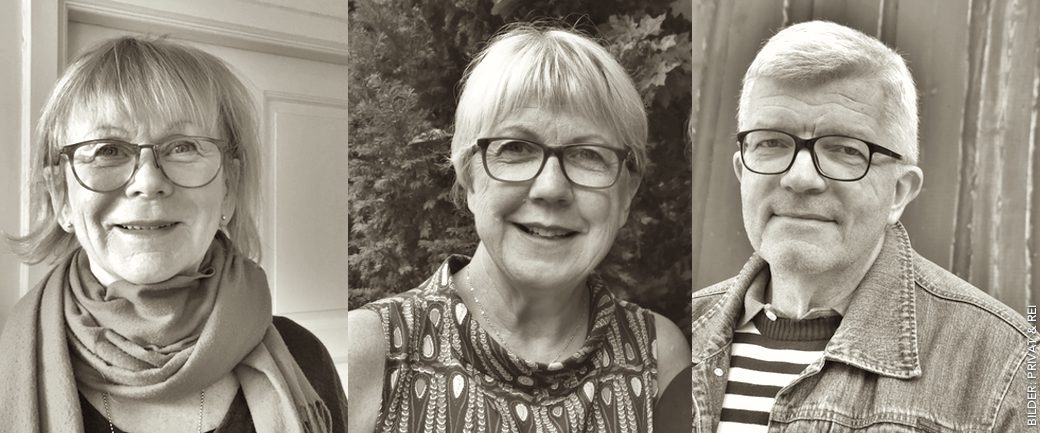
Kerstin Lagrell, Sonja Lundmark, and Per Alnervik. Photo: Private and Reggio Emilia Institute.
First of all, we would like to welcome discussion about what might be problematic with Reggio Emilia-inspired pedagogy. Criticism is important to us, even uncomfortable criticism. But when we read Folkmans licentiate thesis and book, we did not recognize the reality she describes. She also strikes at the heart of what is most important and most wonderful about this philosophy and practice—our listening to children—by claiming that our way of listening has become an obstacle to this very important listening. We must respond to this because none of us recognize ourselves in it.
Sara Folkman should also be aware that there is no certification process for preschools or schools to be called Reggio Emilia-inspired, which means that the inspiration can be interpreted very differently depending on one's knowledge and experience. That is why her research raises so many questions, not least how an interview study of six of all the preschools that call themselves Reggio Emilia-inspired can suffice as research data to label this entire inspiration as a "regime of truth."
In front of Modern Barndom sit three members of the Reggio Emilia Institute's board, each with a well-read copy of Sara Folkman's book "Distance, Discipline, and Dogma: On Listening in Reggio Emilia-Inspired Education" (Liber, 2018). Her licentiate thesis, "Distance, Discipline, and Dogma: On Conditional Listening in Preschool. A Study of Listening in Reggio Emilia-Inspired Education" (Stockholm University, 2017), is also available here.
Sonja Lundmark, chair of the Reggio Emilia Institute, has worked in and managed preschools and schools in Luleå for decades.Per Alnervikhas done the same in southern Sweden, not least in Jönköping, where he was head of HallonEtts preschools for many years. Kerstin Lagrellworked as a preschool teacher at Solskenet preschool in Uppsala for many years before becoming a primary school teacher at Solskenet school and then a teacher trainer at Uppsala University.
They also have extensive experience in mentoring and training educators in various contexts, and over the years they have gained considerable insight into the work of many preschools (and schools). They share this with the other members of the board, who usually meet here in the old chief physician's villa in Stockholm, which is rented by the Reggio Emilia Institute. Today, the surrounding buildings are filled with children and educators. What was once a mental hospital, Konradsberg Hospital, and for several years also the Teacher Training College before it moved to Stockholm University, has now been taken over by many preschools and schools.
"Of course, it can be like Folkman describes," says Per. Or if it's Kerstin or Sonja. Their words overlap, as engaged conversations often do. Even though they themselves have not seen anything resembling the non-listening and distancing care that Folkman describes based on his interviews with 19 educators and 18 children at six preschools that claim to be inspired by Reggio Emilia. The times they have encountered a preschool that has come close to this are very few.
Of course, we can see shortcomings sometimes. But I have never encountered the distancing and observing of children that Folkman describes. There are always risks with a philosophy like this, of course, in that it can take on a life of its own and be interpreted in different ways, which is both its strength and its weakness, says Sonja.
Neither we nor the municipal preschools in Reggio Emilia, which are the source of our inspiration, have any set methods for how it should be practiced. This is about a philosophy and an approach based on democratic values. The strange thing is that she writes that we have such methods, and that educators are kept in check by them, Kerstin continues.
– Furthermore, she invalidates the educators when she interprets them as part of a regime of truth, when they express that they are positive about the Reggio Emilia inspiration. And collegial learning – which she calls adjusting behavior – is something that everyone is involved in today, which is also highlighted as important in the preschool's governing documents.
Of course, there is a risk, Per continues, that practical examples that are so important to highlight can also be interpreted as methods, which in a way they also become. But they vary depending on the context in which they are used and made into daily practice. Sharing thoughts and working methods is important for developing our various practices, and participating in collegial learning creates important tools and suggestions for how educational practices can be implemented.
They have found many misunderstandings in Folkmans book, but also many obvious errors about what Reggio Emilia's educational philosophy is and stands for.
“We also wonder how she arrived at her conclusions based on the methods she chose. Her questions are important, and we need to discuss them further. But we don’t recognize her analysis and interpretation at all, and there is also a big gap between it and her research material, which consists solely of interviews that should not be used to interpret an entire philosophical practice,” Sonja points out.
Yes, like here on page 7 of the book, where she writes that she is conducting a thorough analysis of all Reggio Emilia inspiration in Sweden based on her study. How can she do that based on interviews in a few preschools, where she has not made any observations? wonders Kerstin, who thinks it seems more like she is trying to substantiate her thesis by doing a literature analysis based on selected parts of literature from Reggio Emilia, or from authors who are inspired by them, and which she angles based on her thesis.
It is customary for researchers to cite other research that does not support their own findings. But Folkman does not mention any such research, even though it exists, which is strange. It is also customary to discuss and problematize one's own research, which she does not do either, says Per.
She also fails to address and relate to everything else that has influenced and continues to influence Swedish preschools during the same period that the Reggio Emilia approach has been gaining ground here. It is as if she interprets everything she sees as negative for Swedish preschools as being the fault of the Reggio Emilia approach. Without mentioning issues such as today's recruitment problems, which lead to a shortage of skilled workers due to the lack of trained preschool teachers and childcare workers. Nor does she mention the municipalities' constant cost-cutting measures, which have led to larger groups of children and larger preschools, which she also incorrectly attributes to the Reggio Emilia approach, as well as the large work teams. But even more strange is that she makes no mention of the curriculum and its impact on content and working methods, says Sonja, continuing:
– And how Folkman sees problems with Reggio Emilia-inspired preschools creating varied and clear environments that she believes control the children. But the curriculum also states that children have the right to a varied and rich environment, and that we want more unencoded materials and fewer traditional toys, which we also share with the curriculum. It is as if she has a romantic view of preschool, from the past, without writing down what it is, or how she wants preschool to be. She does not agree that preschool has a curriculum, which we do. In addition, she seems to interpret everything that is part of today's zeitgeist as being related to Reggio Emilia.
Yes, the spirit of the times cannot be kept so isolated, and to omit the curriculum and its impact is inconceivable, according to both Kerstin and Per.
“I also wonder if we have had as much influence in Swedish preschools as she attributes to us,” Per reflects. “There are many different approaches, not least the developmental pedagogy developed by Ingrid Samuelsson Pramling and her colleagues at the University of Gothenburg, as well as Montessori, Waldorf, and outdoor education. Of course we have had an influence and should be scrutinized, but to call it a "doxa" ... In Jönköping, where we have had active networking around Reggio Emilia inspiration for many years, perhaps 8-10 percent of the approximately 130 preschools in the municipality call themselves Reggio Emilia-inspired today.
"What strikes me most in the book is Chapter 4, where she writes about this very Reggio doctrine. She interprets her findings quite extensively there, with accusations about what this inspiration has caused. It almost feels as if she has a thesis that she is promoting from the outset, and that she interprets all the answers she receives in such a way that they support this particular thesis," says Sonja.
– What do you say about the gray boxes then? The "cases" she highlights at the end of the book, on pages 133, 138, and 139? Like the hair-raising example of the teachers who tape their mouths shut for a couple of days to train themselves to listen to the children. Where do these examples come from? Most of them are completely without references. Are they really observations – or just examples she has made up? It is very unclear, and she does not state that she is basing her study on them, Kerstin points out, continuing:
I also react to her questions to the children. How do children interpret a question such as "Do you feel that adults listen to you?" It is difficult to interview children. Folkman also mentions this on page 15 of the book, that there is a lot of criticism against using interviews with children as a basis for research. Nevertheless, she does so and also draws firm conclusions based on them.
Conclusions that all three of them strongly object to at the beginning of this interview, because Folkman, with these as support, criticizes what is such an important part of Sonja's, Per's, and Kerstin's inspiration, indeed what the entire Reggio Emilia philosophy is based on.
Listening is not just about listening to children's learning processes. Of course, it also happens in all close and everyday care situations. Listening is about so much more than just hearing what children say. It's about how we listen carefully to them, being able to perceive what and how they do things, but also what and how they don't do things, and based on that, prepare environments and use documentation before we move forward with a project, explains Kerstin, who also wants to say something about the lack of care that Folkman believes he has seen in his study:
– Care is about so much more. Caring for each other, between educators and children and between children, but also about materials, tools, and the environment, both indoors and outdoors. And caring for nature, of which we are all a part. This is truly something that characterizes Reggio Emilia's educational philosophy, which is based on democratic values. Of course, there can be variations and shortcomings when it comes to both listening and care, even when it comes to play, which she also criticizes us for. But as Modern Barndom's theme issue last fall showed, it is important to us (MB 4/18, about, among other things, a research study in which educators, together with researchers, spent three years investigating the importance of play in a Reggio Emilia-inspired preschool. Editor's note).
Based on all the questions and objections that Sara Folkmans research undoubtedly raises, Sonja Lundmark, Per Alnervik, and Kerstin Lagrell believe that her claim rings hollow when it comes to conducting a thorough analysis of all Reggio Emilia-inspired preschools in Sweden. Nevertheless, they return once again to what they also stated in one of their first versions of the board's "response" to Pedagogiska Magasinet, in response to a review of Folkman's book (in PM 1/19): "even Reggio Emilia-inspired preschools must be mindful of how they put their thoughts and words into practice,"and:
"It is always beneficial when those of us who provide this inspiration are challenged, as it leads us to reflect and question how we should express ourselves. What do we want to work for, how do we listen, how do we show care for the children, and how do we stage our educational practice? Many people will probably recognize the description in the text about ending up in new normalities and the difficulty of thinking outside the box. We have Folkman to thank for this, and we urge preschools around the country to take it up and discuss it. It is about having the courage to put yourself on the line, which also requires us to build trusting relationships where we dare to show our inadequacies and our strengths."
The Reggio Emilia Institute Board's response to Kajsa Holmgren's review of Sara Folkman's book in Pedagogiska Magasinet No. 1/19 will be published in Pedagogiska Magasinet No. 2, which will be released on May 8.
While Modern Barndom was working on this group interview, another review of Folkmans book appeared in the magazine Förskolan (by Kent Roslund in issue 3-2019), whose uncritical praise was strongly questioned by Sonja, Per, and Kerstin, who immediately began writing a response to it as well.
But don't you also encounter uncertainty about educational documentation sometimes? That you wonder how you'll have time for everything, and time for the children? asks Sonja.
Yes, but that is precisely why educational documentation is so important, because it is about making visible what children and educators do and say, as well as making visible the planning process in order to identify children's interests and possible continuations of the teaching. It is important because it allows us educators to really see ourselves, how what we say and do affects the children. Educational documentation highlights the practical aspects in a different way than quantitative measurement, explains Per, referring to other documentation that plays a major role in teaching and education today but is not sufficient to describe the quality of the work with children and young people.
I see us as a resistance movement against the prevailing culture of measurement, says Kerstin, pointing out that educational documentation can never be about detached observation. Ethics is such an important part of this, which Folkman seems to have completely missed in his criticism.
If there is one thing that preschools really discuss, it is when, where, and how to document. Of course, we can't know how everyone does it. However, we do know how educators in preschools in Reggio Emilia describe this documentation practice, which we convey: that it's always about being on the children's side, not taking photos all the time, and creating a good context where the documentation is definitely not the main focus, but rather the interaction between children and adults, adds Sonja.
“Educational documentation is also important for parents,” Per continues, referring to Karin Alnervik, Charlotte Öhman, Eva Lidén, and Monica Nilsson’s article “Children and guardians’ memories of participating in educational documentation,” published by Nordisk Barnehage, which shows that educational documentation practices contribute to creating a community of practice in preschools. This, in turn, enables the preschool to conduct democratic teaching.
What has always been so important for municipal preschools in Reggio Emilia: seeing the youngest children and their schools as a central part of democracy. This was also what made Sonja Lundmark, Kerstin Lagrell, and Per Alnervik fall in love with this educational philosophy and then be inspired by it. But they don't just want to protect democracy in preschool, they want to protect it everywhere, even in a debate like this one.
We therefore welcome Sara Folkman's perspective and criticism, even though we question much of what she presents. Perhaps her book can even contribute to a more in-depth conversation about Reggio Emilia's educational philosophy and practice in Sweden? If it can also lead to a more nuanced dialogue based on scientific curiosity, it may even serve an important function.
Kerstin, Per, and Sonja's words once again intertwine as they approach the end of this interview, while hoping that more and more people will take up the baton.
– We also want to welcome respectful and open dialogue with other educational perspectives in Swedish preschools. We believe that we can learn from each other, but that it is also important that we work together to highlight what we agree on and what we disagree on. The reality of preschool is not black and white – and no one benefits from digging trenches.