
Carlina: I miss you. We miss you.
Harold Göthson remembers Carla Rinaldi
April 23, 2025
Carla Rinaldi passed away on April 16, after a short illness. As one of Reggio Emilia's most influential voices, her work has left its mark far beyond Italy's borders. In this memorial text, Harold Göthson honors his colleague and friend, a person whose vision for children, education, and democracy continues to shape the future.
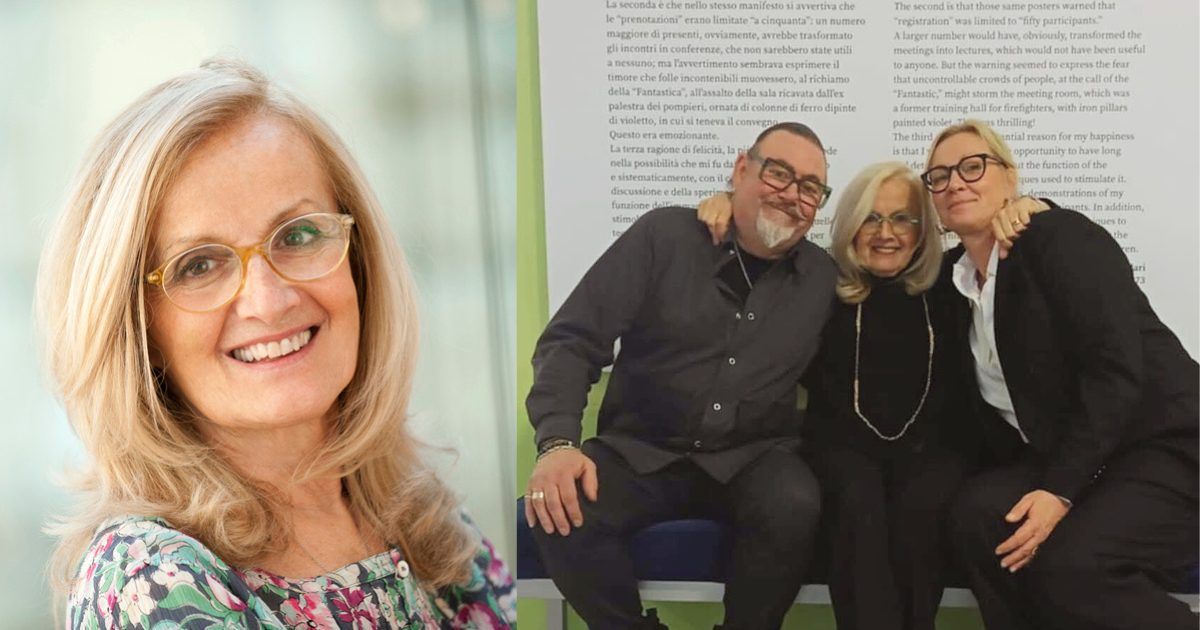
Caption: Portrait of Carla Rinaldi, along with a photo of Reggio Emilia Institute CEO Greger Rösnes, Carla Rinaldi, and Reggio Emilia Institute Chair Anna Söderström Ahrborn taken in Reggio Emilia in December 2024.
During a brief period of illness, Carla Rinaldi stubbornly continued to work until the afternoon before she died. Wednesday, April 16.
My grief is shared by everyone at the Reggio Emilia Institute and around the world. All of us who were close to her affectionately called her "little Carla": Carlina. I got to know her more than thirty years ago, and when we became friends, she called me Haroldino.
I would like to tell you about a common friend and extraordinary person who integrated her grand persona with her everyday life. She saw many people as part of her large family. Her quest for love colored her thoughts and voice.
Carlina was the first educator to start working with Loris Malaguzzi. Together with many others, they have made Reggio Emilia's preschools and approach to education a right for all. A right to participate and contribute to the development of the city's democratic citizenship. Preschools have been seen as a tool for meeting society's democratic needs with democratic education. This has inspired democratically minded people from all over the world, not only preschool professionals but all educators, as well as researchers, artists, politicians, and, not least, everyone involved in learning—in preschool, first and foremost, the children's families—their context and community. For them, pedagogy was and is linked to the democratic mission.
And this, as Vea Vecchi has often shown us Swedes, is linked to the concrete creative multilingual environment associated with Reggio Emilia's studio culture.
Just as Vea has become the epitome of what an atelierista can and should be, Carlina has been the epitome of what a pedagogista should and can contribute in collaboration with educators and atelieristas. All with a special responsibility to contribute, through their collaboration, to children being able to explore democratic values in their context, as Carlina puts it in conversation with professors Gunilla Dahlberg and Peter Moss in her book "In Dialogue with Reggio Emilia" (Routledge). This is how she formulates Reggio Emilia's view of the curriculum.
Just ten days before she died, she took part in her last assignment outside Italy. It took place in Västerås, Sweden, together with members of the Reggio Emilia Institute who, after a period of talks, discussions, and workshops, made a decision about their vision and mission in our time. She was clearly affected by her illness, but with her sharp intelligence she saw not only Sweden's but all Reggio Emilia inspirers' mission to look ahead with "nostalgia for the future."
It is symbolic, however, that she ended up with us in Sweden at the Reggio Emilia Institute. A country that meant so much to her personally through her short marriage to Carl-Hugo and her encounter with his circle of children, both young and old, and with Öland. She was also a close friend of Anna Barsotti – and her husband Carlo – who was one of the founders of the Reggio Emilia Institute. In Västerås – as planned by the institute's chair Anna Ahrborn and CEO Greger Rösnes – she was asked why the manifesto that had been drawn up chose to use "the right to quality in education" knowing how difficult the concept of quality is to understand. She replied that quality is not something that is determined once and for all, but rather a quest to explore what the concept can and should mean in all educational contexts, guided by an understanding of the values of democracy in its context.
Even though these values are not stable either, but must be explored in concrete projects, they are nevertheless the starting points for all exploration. In the book "Making Learning Visible," she writes a chapter early on about these values: The value of everyone's voice The value of the nuances and differences in these voices The value of creating participation through negotiation The value of civic learning that broadens through multilingual expressions and perspectives. These are the leading values for me, but in the chapter she formulates more – not least the value of play as an element of learning. In her reasoning, she was able to apply her early interest in studying philosophy and the history of ideas. This was the background to her starting to work as a pedagogista together with Loris Malaguzzi and the city's preschools.
This was certainly one of the reasons why she was awarded the Danish Lego Prize in 2015, as was Loris Malaguzzi before her. Since then, she has sought close collaboration with the Lego Foundation.
When Loris Malaguzzi died in 1994, Carlina became his successor and later chair of the company created to "make Reggio Emilia a port where we could meet and exchange goods from all over the world," as Loris Malaguzzi put it when describing the elusive idea of what Reggio Emilia's inspiration could be for the world. He also said that no child in Reggio Emilia can be happy if children and childhood are suffering in the world.
When Mayor Graziano Del Rio took the initiative in 2011 to supplement the internationally oriented company Reggio Children with the non-profit international Fondazione Reggio Children – Centro Loris Malaguzzi, it was obvious to propose Carlina as chair. Since then, I have represented an international perspective on the board, together with Margie Cooper from NAREA (the American partner organization of RE). The city had already created the Centro Loris Malaguzzi development and research center in the converted premises of the old Locatelli Parmesan factory, with city studios, lecture halls, exhibitions, a bookstore, and the research-oriented restaurant Pause. This was all part of a strategy to breathe new life into the old, run-down factory area in Santa Croce behind the station, where many immigrants had sought accommodation.
During his fifteen years as chair, the fund developed many projects for ages 0–99, based on the city's preschool experiences, in collaboration with various contributors such as Fare Scuola, ………., and the doctoral program Reggio Emilia's Childhoods. One project that can be highlighted as an example of international collaboration is the collaboration with the Lego Foundation, the so-called P.E.R. project with conferences in several locations around the world. The week after Carlina returned from Sweden, such a conference took place in Boulder near Denver, Colorado. Carlina could only follow this online. She always wanted more, and last fall, the organization known as Remida moved into a repurposed space in the old Caffari factory.
In the end, her final days were spent working for the future. When the news of Carlina's death became known, condolences poured in from famous and unknown people from all over the world. Newspapers and television reported on her passing in and around Reggio and throughout Italy.
When she was buried on Good Friday, it was as honorary chairwoman of the fund, but also as a particularly honored person in the city. Before the thanksgiving ceremony held in the Sala Tricolore in the town hall by Mayor Marco Massari—surrounded by his two predecessors, Luca Vecchi and Graziano Del Rio—many people filed past her coffin for a final farewell. In many speeches from her family and others, including Cristian Fabbi from the foundation and Daniela Lanzi from the preschools, they said goodbye with gratitude to a true citizen of the city. For those who could not fit into the Sala Tricolore, there were TV screens outside in Piazza Trampolini.
Carlina was a close friend and colleague to me, who integrated her great importance into a person who will now grow and symbolize yet another voice from the city of Reggio Emilia's call to continue to protect the fragility of democratic citizenship and the right to an education that provides democratic education in our time. This permeated the conversation that Leicy and Fia from the institute's board fortunately had with Carlina in the Reggio Emilia Institute's newly launched podcast.
Farewell Carlina: I miss you. We miss you.
Greetings from Haroldino
Harold Göthson
Stockholm, April 21, 2025
Harold Göthson is one of the founders and former leaders of the Reggio Emilia Institute. Since 2011, he has been a board member of Fondazione Reggio Children Centro Loris Malaguzzi.